

Understanding Optimal Binary Search Trees
📚 Dive into optimal binary search trees: basics, optimization methods, algorithms, and comparisons in data structures for students & pros alike.
Edited By
Sophie Clarke
Binary trees form the backbone of many data organisation strategies in computer science. At their core, these structures consist of nodes, each linking to up to two child nodes — typically labeled as left and right. This simple arrangement allows for efficient storage, retrieval, and processing of hierarchical data.
You find binary trees everywhere: from search algorithms and expression parsing to file system indexing and priority queue implementations. Their efficiency in organising data directly impacts performance in databases, compilers, and even artificial intelligence systems.
A binary tree is often defined recursively: each node serves as the root of its subtree, providing a clean, manageable way to navigate complex data sets. The depth and balance of a binary tree influence how quickly you can traverse or modify its contents.
Effective use of binary trees reduces computational time and memory overhead, which can be a game changer in large-scale software applications.
Node: The fundamental unit containing data and pointers to children.
Root: The topmost node where traversal begins.
Leaf: Nodes without children, marking endpoints.
Height: The longest path from root to leaf.
Binary trees come in different flavours too, like full, complete, perfect, and balanced forms — each affecting storage and access differently. For example, balanced trees keep depths even, ensuring consistent operation times, while skewed trees can degrade to linked list behaviours.
Understanding these subtleties helps in choosing the right binary tree variant to optimise tasks like searching, insertion, and deletion. This foundation sets the stage for studying traversal methods and practical applications in sections ahead.
Binary trees form a foundational concept in computer science, and understanding them is key for anyone working with complex data structures. They help organise data in a way that makes searching, sorting, and managing information more efficient, which is particularly useful in applications like databases and file indexing. For traders and analysts, for instance, efficient data handling translates to quicker insights and better decision-making.
This section lays the groundwork by explaining what a binary tree is, the structure it follows, and the common terms you will encounter. Getting familiar with these basics helps when you move on to more advanced topics like binary search trees or traversal techniques.
A binary tree is a hierarchical data structure where each node has at most two children, often referred to as the left and right child. Unlike a simple list or array, a binary tree organises data in a branching form, resembling a tree — only upside down with the root at the top. This structure is practical when you want to represent relationships or priorities, such as organisation charts or expression trees in compilers.
Think of it like an ancestral family tree — a grandparent node with two child nodes, and so forth. The binary restriction (maximum two children) maintains simplicity and makes certain algorithms like binary search work efficiently.
A binary tree consists of nodes (the data points) connected by edges (the links between nodes). Each connection forms a path from one node to another. The topmost node is called the root, and nodes below it form different levels. Level indicates how far a node is from the root — the root is at level zero, its children at level one, and so on.
This notion of levels helps in organising data and controlling the depth of the tree. For example, in file systems, you might want to limit the depth of folders for easy navigation. Moreover, understanding edges and levels is important when you design traversal algorithms to read or modify the tree.
The root node is the starting point of the binary tree—it has no parent. Every other node has one parent node but can have up to two child nodes. A node’s children are known as its left and right child, and this allows the tree to branch.
Leaf nodes are the ones that have no children. These terminal nodes often contain the actual data or results you want to retrieve or process. In a payment processing system, for example, leaf nodes might represent individual transactions, while higher nodes categorise those transactions.
The depth of a node is the number of edges from the root to that node. Conversely, the height of a node is the longest path from that node down to a leaf. The height of the entire tree is the height of its root node.
These two measures are more than just technical terms—they affect the performance of tree operations. A tree with large height can slow down search or insertion, so algorithms often aim to keep the height minimal (balanced). For instance, in stock market data structures, balancing the tree ensures quick data retrieval during volatile trading.
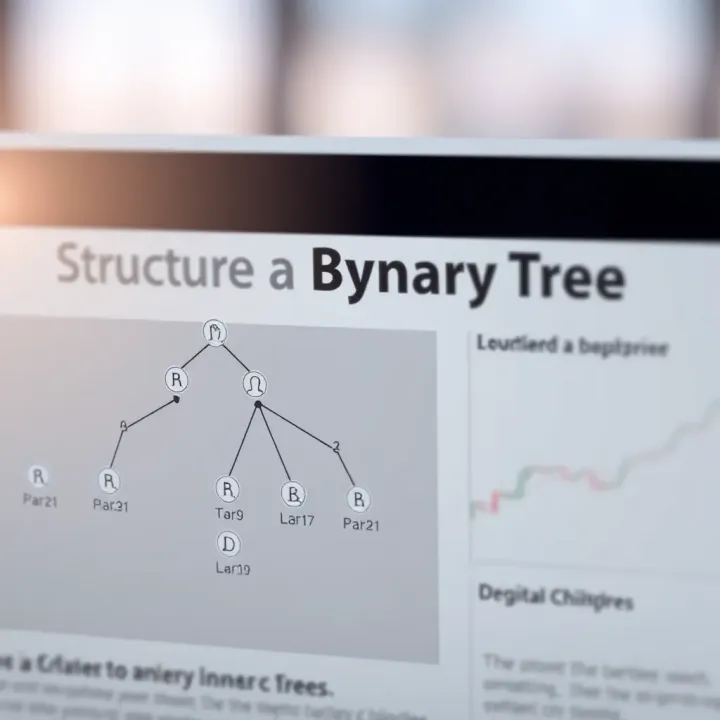
Understanding these basic elements of binary trees helps you design and work with them more effectively, forming a base for the advanced structures and algorithms explained in later sections.
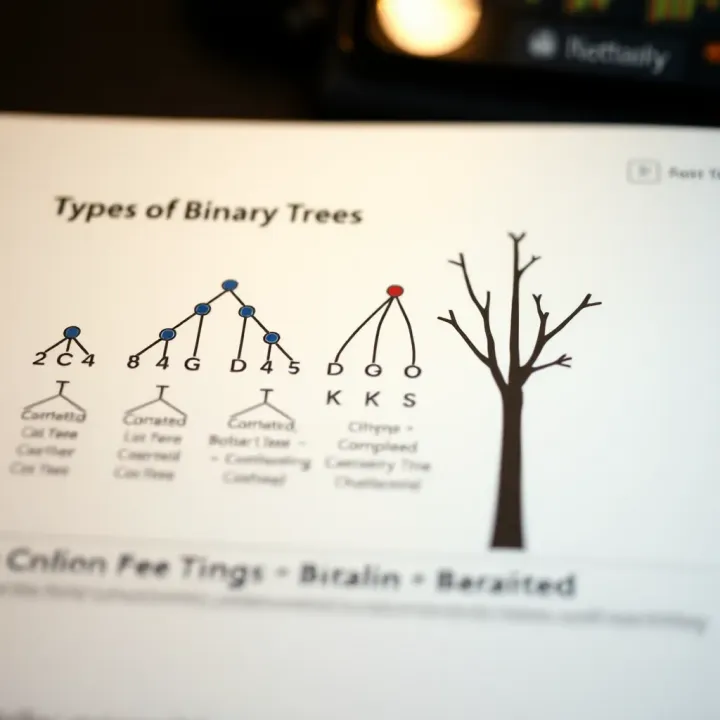
Understanding the common types of binary trees helps clarify how variations in structure impact their performance and application. Each type comes with specific rules about node arrangement, which influence how efficiently data is stored, accessed, or modified. This knowledge is essential for developers, analysts, and educators aiming to choose the right kind of binary tree for their computing needs.
Defining characteristics: A full binary tree is one where every node has either zero or two children, never just one. This structure ensures that nodes are completely filled at except the leaves. In contrast, a complete binary tree fills all levels fully except possibly the last level, which fills from left to right without gaps. The difference lies in the strictness of node placement at the last level, with full trees allowing only nodes with zero or two children, while complete ones focus on filling levels consistently.
Use cases: Full and complete binary trees are well-suited for scenarios that require balanced workload distribution and predictable performance. For instance, heap data structures, often used in priority queues, rely on complete binary trees for efficient insertion and deletion. Their structure ensures minimal height, which keeps operations like insertion and deletion close to O(log n) time, beneficial for software like job schedulers or bandwidth management in network routers.
Differences between perfect and balanced trees: A perfect binary tree goes a step beyond full and complete by having all leaves at the same depth and every node owning two children. Balanced trees, meanwhile, may not be perfect but keep their height minimal by distributing nodes evenly. The emphasis in balanced trees is on height difference between subtrees, which could be minimal like in AVL or Red-Black trees. This flexibility allows balanced trees to accommodate more dynamic data insertion or deletion without degrading performance drastically.
Importance in algorithm efficiency: Balanced binary trees maintain operations such as searching, insertion, and deletion close to O(log n) time by preventing their height from growing too tall. Without balance, these operations could degrade to O(n) in worst case, resembling a linked list, which leads to slow performance. Particularly in database indexing and real-time applications, balanced trees reduce the chance of bottlenecks by ensuring quick data access and update times.
Properties of BSTs: Binary Search Trees impose a specific order: all nodes left of a parent hold smaller values, while nodes on the right hold larger values. This property allows BSTs to speed up search queries tremendously compared to unorganised trees. For example, when locating a stock price within a structured dataset, a BST narrows down the search path by half at each comparison step.
Advantages over generic binary trees: Unlike generic binary trees, BSTs enable faster searching, inserting, and deleting because of their ordered structure. They suit applications like dynamic databases or online trading platforms where data are added and queried frequently. Also, BSTs form the basis of various complex data structures like self-balancing trees, which further improve stability and efficiency for large-scale systems.
Understanding these types of binary trees assists in making informed decisions when building data structures that are efficient, scalable, and reliable for real-world computing tasks.
Traversal methods are essential for accessing and manipulating the data stored in binary trees. Without a systematic way to visit every node, applying operations like searching, updating, or printing data becomes inefficient or impossible. Each traversal technique offers different perspectives on the structure, impacting how algorithms process tree data.
Inorder traversal visits nodes in the left subtree, then the root node, followed by the right subtree. This approach is especially important in binary search trees (BSTs) because it produces node values in sorted order. For instance, if you use inorder traversal on a BST containing stock prices, it would provide these prices in ascending sequence, facilitating quick analysis or range queries.
Preorder traversal starts with the root, then recursively visits the left subtree followed by the right. It captures the structure of the tree itself, making it useful for tasks like copying or serialising the tree. In financial models or portfolio trees, preorder traversal helps replicate structures or transmit data hierarchies, maintaining the parent-child relationships intact.
Postorder traversal first explores both left and right subtrees before visiting the root node. This method suits scenarios where you need to process children before handling the parent—for example, deleting nodes to free up memory or evaluating expression trees in compilers. In algorithmic trading software, postorder traversal can be used to compute final results after processing individual components.
Level-order traversal visits nodes level by level, starting from the root and moving downward. It uses a queue to ensure nodes at a given depth are processed before moving deeper. This method reveals the tree's breadth and is particularly helpful when balancing trees or performing operations that rely on proximity, such as network broadcasts or hierarchical data visualisation.
For example, while analysing a decision tree in investment strategies, level-order traversal allows analysts to observe options at each decision level before diving deeper. This can simplify understanding immediate consequences and branching opportunities.
Traversal techniques not only enable basic data access but also influence algorithm design and efficiency across real-world applications, from database indexing to expression parsing.
By mastering these traversal methods, traders, analysts, and educators can gain better control and insight into data structured via binary trees, optimising both performance and accuracy in their computational tasks.
Understanding basic operations and algorithms on binary trees is essential for anyone working with data structures. These operations form the backbone of how data is added, removed, and searched within trees, which directly impacts performance and efficiency in real-world applications such as database indexing, syntax parsing, and more.
How to insert nodes: Insertion in binary trees generally depends on the type of tree and its intended use. For a simple binary tree, nodes can be inserted at the first available position in level order to maintain completeness. However, in Binary Search Trees (BST), the insertion process follows an ordered approach. Each new value is compared with existing nodes starting from the root, traversing left or right depending on whether the new value is smaller or larger, until an appropriate leaf position is found. This keeps the tree structured for efficient searching.
For example, inserting 40 in a BST that has 30 as root and 50 as right child means placing 40 as the left child of 50. This ordering is critical for keeping search operations fast.
Deleting nodes and rebalancing: Deleting a node from a binary tree involves more care, especially in BSTs. If the node is a leaf, removal is straightforward. But if it has children, adjustments are necessary to maintain tree structure and properties. Usually, the node is replaced by either the largest node from its left subtree or the smallest node from the right subtree, preserving order.
In many cases, repeated deletions can unbalance the tree. To maintain performance, self-balancing trees like AVL or Red-Black trees come into play, automatically performing rotations and rebalancing after deletions. This ensures operations remain efficient, which is critical for time-sensitive applications like trading algorithms or large-scale data queries.
Linear search vs binary search: Searching in a generic binary tree often uses linear search methods, which explore nodes one by one, typically with traversal algorithms like breadth-first or depth-first search. This can be time-consuming since it may require checking many nodes.
On the other hand, binary search takes advantage of BST properties, comparing the target value at each step and moving left or right accordingly. This reduces the average search time significantly.
Optimising search using BST properties: BSTs cut down search time from linear to logarithmic (O(log n)), by pruning half of the search space at every node. In a balanced BST, this makes searching efficient even for millions of nodes. Such optimisation is valuable in financial systems where quick lookups of transaction history or stock prices are frequent.
Recursive methods: Calculating the height (maximum depth) or the size (number of nodes) of a binary tree is often done using recursion. The function calls itself for the left and right children, then returns the maximum height plus one or sums the sizes. This method is simple and closely matches the tree’s structure.
For example, height calculation works by returning zero for null nodes and adding one for each level up. This helps in checking tree balance or estimating time complexities.
Iterative approaches: While recursion is elegant, iterative methods using stacks or queues can also find height and size without risking stack overflow in very deep trees. Level-order traversal is a common iterative way to count nodes and determine height by tracking levels. This method suits environments with limited memory or when processing very large trees, such as in big data applications.
A well-maintained binary tree with efficient insertion, deletion, and search operations ensures that data handling remains swift and reliable—key for any system relying on structured data storage.
Overall, mastering these basic operations and algorithms not only helps in creating and manipulating binary trees but also forms a foundation for more complex data structures and problem-solving techniques used in computer science and software development.
Binary trees have wide-ranging applications that make them indispensable in computing. They not only organise data efficiently but also improve processing speed across various systems. Knowing how these structures operate in real-world contexts can deepen your understanding and open up practical uses, especially in data-heavy environments.
Organising and indexing data: Databases often rely on binary trees to index records, which enables faster search and retrieval. For instance, a binary search tree (BST) can index customer records in a banking system by account number, allowing quick lookups without scanning the entire dataset. This indexing reduces query times significantly compared to linear searches.
Binary trees in hierarchical structures: File systems use binary trees to represent folder hierarchies. Each node may represent a folder or file, with child nodes showing subfolders or contents. This structure helps operating systems quickly access files by traversing from the root directory down the tree, making file management efficient even with complex directory systems.
Syntax trees: Compilers convert source code into a tree-like structure called an abstract syntax tree (AST), which is a type of binary tree. Each node represents language constructs such as operators, variables, or function calls. This hierarchical model simplifies understanding and processing of code, enabling optimised compilation and error checking.
Evaluation of mathematical expressions: Expression trees are a specific application in which each internal node is an operator (like + or *), and leaves are operands (numbers or variables). Evaluating such a tree follows recursive rules, where sub-expressions are computed from the bottom up. This approach is fundamental in calculators and interpreters to handle complex equations efficiently.
Binary search trees in sorting algorithms: BSTs help maintain dynamically changing datasets in sorted order. By inserting elements into a BST, an inorder traversal outputs them sorted. This mechanism underpins sorting algorithms like tree sort, which can outperform some traditional sorting methods, especially when dealing with data already close to sorted.
Balancing trees to improve performance: Unbalanced binary trees can degrade into linked lists, making operations linear time rather than logarithmic. Balanced trees, such as AVL or Red-Black trees, redistribute nodes to maintain minimal height. This balancing ensures that search, insertion, and deletion remain efficient even as the dataset grows large.
Efficient data handling comes down to smart organisation, and binary trees offer a practical framework that supports quick access, dynamic updates, and clear hierarchies – vital in modern computing tasks.
📚 Dive into optimal binary search trees: basics, optimization methods, algorithms, and comparisons in data structures for students & pros alike.

Explore binary trees 🌳, a vital data structure in programming. Understand their types, practical uses, and traverse methods with a clear coding example in this guide.

Explore how numbers work in binary form 💻 Learn basic principles, conversion methods, arithmetic operations, and real-world uses, ideal for tech enthusiasts in India 🇮🇳
Learn how Optimal Binary Search Trees 🧠 improve search efficiency with clear insight into their definition, costs, construction, and real-world uses in computing.
Based on 7 reviews