

Best Case Time Complexity of Binary Search
🔍 Understand the best case time complexity of binary search, learn when it happens, its effect on performance, and how it differs from average and worst case scenarios.
Edited By
Liam Foster
Binary search is a widely used algorithm, especially in scenarios where you need to find an element in a sorted list efficiently. What makes it stand out is its ability to reduce search time drastically compared to a simple linear scan. When we talk about the best case time complexity of binary search, we refer to the minimum steps it requires under the most favourable conditions.
Unlike average or worst case scenarios, where the search might need multiple checks, the best case occurs when the target element is found immediately—usually right at the middle of the sorted array. In this fortunate situation, the algorithm completes in just one step, giving it a best case time complexity of O(1), meaning constant time.
Understanding this helps traders, analysts, and educators grasp how algorithm efficiency can vary with input. While the average time complexity is O(log n) (where n is the number of elements), reflecting the halving process at each step, the best case shows the absolute lower bound on runtime.
To put it simply, imagine looking for a particular name in a phonebook that's arranged alphabetically. If your first flip lands exactly on the page containing that name, you found it instantly—this illustrates the best case. But if you don't, you'll keep halving your search area until you zone in on your target.
The best case time complexity of binary search shows how quick the algorithm can be when luck favours you, but practical use usually involves multiple comparisons.
In programming, recognising this helps optimise code paths that may benefit from early exits or quick matches. For example, if you know your most frequent searches hit the middle or close to it, performance gains can be significant.
Summarising, the best case time complexity of a binary search highlights the scenario where the search is resolved in a single step (O(1)), reinforcing why binary search remains a powerful tool in sorted data retrieval.
Binary search is a fundamental algorithm often used to find a specific value within a sorted dataset quickly. Its efficiency rests on halving the search space with each step, making it far more efficient than checking each element one by one. Understanding how binary search works is essential for grasping its time complexity and practical applications, especially in fields like trading algorithms, data analysis, and computer science education.
Binary search requires the input data to be sorted beforehand. This is critical because the algorithm exploits the order of elements to eliminate half of the remaining search space at each comparison. For example, if you're searching for a stock price in a sorted list, you can directly jump to the middle price and decide whether to look left or right, rather than scanning sequentially. Without sorting, the binary search logic breaks down and won't provide faster search times.
The algorithm follows a divide and conquer strategy, where each step splits the problem into smaller subproblems. After examining the middle element, the search moves to either the left or right half, cutting down the list logarithmically. This approach reduces the number of comparisons dramatically, especially with large datasets like financial records or databases with millions of entries. This efficiency makes binary search a preferred method over linear search in sorted contexts.
The first crucial step involves picking the middle element of the sorted list and comparing it with the target value. If they match, the search ends immediately. For instance, consider a sorted array of product prices on an e-commerce platform like Flipkart; seeking ₹1,200, the algorithm checks the middle price first. If the middle price is ₹1,200, you’re done in just one step — this represents the best case.
If the middle element does not match the target, the algorithm decides which half to search next. If the target is less than the middle element, the right half is discarded, and the search continues on the left half, and vice versa. This boundary adjustment keeps narrowing the search area until the target is found or no elements remain. Such targeted elimination drastically reduces the search time compared to scanning every entry.
This clear structure of binary search is key to understanding its best case time complexity, which occurs when the desired element is found on the very first middle check.
Understanding the best case time complexity helps in grasping how quickly an algorithm can perform under ideal circumstances. Unlike average or worst cases, which account for typical or challenging inputs, the best case scenario shows the minimal number of operations needed when everything aligns perfectly. This perspective is useful for recognising situations where a search might be completed quickly, saving resources and improving system responsiveness.
Contrast with Average and Worst Cases
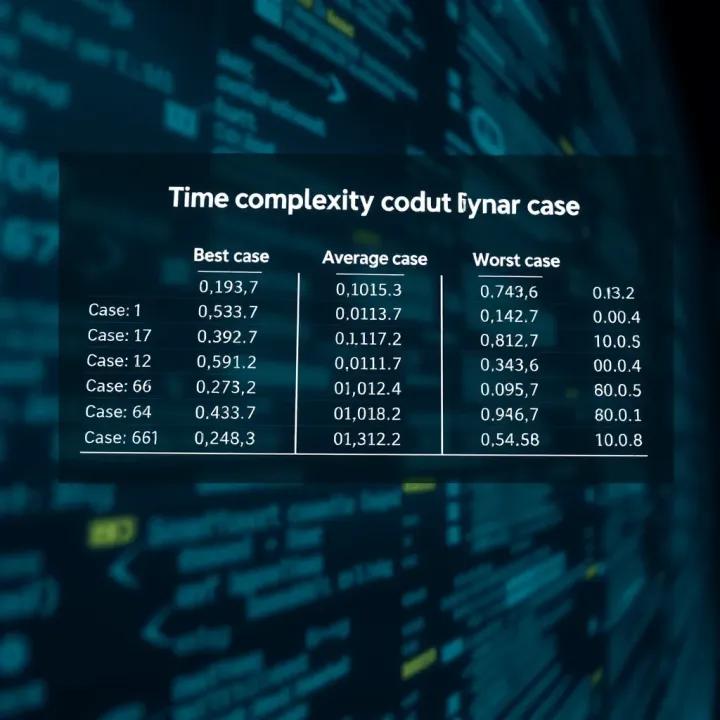
Best case time complexity measures algorithm performance under the most favourable conditions. For example, in binary search, the best case happens when the target is found at the first comparison itself. In contrast, the average case accounts for the expected number of operations when the target could be anywhere in the dataset, and the worst case considers the scenario requiring the maximum comparisons, often when the target is near the ends or absent. Recognising these differences helps in setting realistic expectations for algorithm efficiency in different contexts.
Significance of Best Case Metrics
Though less commonly emphasised than average or worst cases, best case metrics offer practical value, especially when fast responses are critical. In trading algorithms dealing with sorted price lists or real-time data feeds, hitting the target quickly can reduce latency. Additionally, best case analysis guides developers to identify scenarios where optimisations can have immediate impact. It can help benchmark algorithms or compare their overheads when lucky cases occur frequently.
Target Found at First Middle Check
Binary search divides sorted data by checking the middle element each time. The best case occurs when the target element is exactly the middle item on the first attempt, requiring no further divisions. This means only one comparison suffices to locate the target, making the search instant from the algorithm’s perspective. This situation arises most often when data is static and queries frequently seek median-like values.
Implications for Operation Count
In this best case, the operation count is minimal and constant. The algorithm performs just one comparison, so the time complexity is considered O(1). Practically, this means the search cost does not grow with data size, unlike the average or worst case where the number of comparisons grows logarithmically with the number of elements. This rapid hit can be a key advantage in systems where certain values are requested repeatedly or caching favours central elements.
Recognising the best case provides insight into the most efficient potential of binary search, reminding us that while worst-case guarantees matter, best-case scenarios show the fastest achievable performance under ideal conditions.
In sum, defining best case time complexity clarifies when and how binary search can operate with lightning speed. While relying solely on best case analysis is risky, knowing these details helps engineers design smarter, faster systems tailored to their data patterns.
Understanding how to calculate the best case time complexity of binary search helps clarify when the algorithm performs at its most efficient level. This focus isn't just academic—it highlights scenarios where the search hits the target right away, thus optimising resource usage. For traders and analysts running frequent queries on sorted datasets, recognising the best case can assist in anticipating lower response times for certain inputs.
The best case occurs when the element we’re searching for lands exactly at the middle of the sorted array on the very first check. Since no further division or comparison is needed, the algorithm completes the search immediately, using just one operation. This constant time scenario means that the search does not depend on the size of the dataset in this specific instance.
Practically, this works well when the data is arranged such that the most commonly searched items are near the centre of arrays, a tactic sometimes used in optimised databases or lookup tables. For example, a stock price lookup system might prioritise entries in a way that popular shares fall in the very middle to speed up access.
Expressing this behaviour as O(1) means the operation count remains constant, regardless of how large the input array is. So whether the list has a hundred elements or a crore, the best case remains a single comparison. This notation is helpful because it communicates that the binary search can sometimes deliver lightning-fast results, serving as a baseline for performance claims.
For educators and students, emphasising this with examples can improve conceptual clarity, making it clear that not every search operation within binary search costs the same time.
In most cases, the search item is not found immediately and the binary search algorithm cuts the search space in half repeatedly. This means several recursive or iterative calls are needed to zero in on the target. The number of these calls depends on the size of the input and the position of the element, but it generally grows as the dataset gets larger.
Understanding this helps analysts design systems that account for delays caused by deeper searches. For example, a stock exchange's real-time query engine can better estimate latency by factoring in average case complexities.
The average and worst cases follow a time complexity of O(log n), where 'n' is the number of elements in the sorted array. This logarithmic behaviour stems from the algorithm dividing the search space by two every iteration. Though this still scales relatively well even for large datasets, it's significantly slower than the constant time in the best case.
This contrast is vital because it reminds developers that while binary search is highly efficient overall, performance can vary with input distribution. Optimising storage and indexing strategies, especially in large-scale applications such as financial trading platforms or educational databases, can reduce occurrences of worst-case searches.
In sum, knowing the best case time complexity provides insight into the efficiency ceiling of binary search but should be considered alongside average and worst cases for realistic performance expectations.
There are situations where certain input patterns make the best case scenario more frequent than usual. For example, if a search system knows that a particular value is often the middle element, it can tweak its approach to capitalise on this, reducing the average search time. This might happen in tier-2 city e-commerce search engines where popular products tend to be positioned centrally in sorted lists due to sorting by sales or popularity.
Optimising algorithms for these inputs can improve user experience with faster query responses. Still, this approach works effectively only when input characteristics are predictable. If the target is seldom in the middle, best case optimisation gives diminishing returns.
Best case time complexity forms a baseline for algorithm comparisons, helping you understand the absolute quickest scenario. When developers benchmark sorting and searching methods, knowing the best case helps set expectations for minimal execution time. For instance, during coding interviews at Indian software firms, interviewees often get asked about best case complexities to demonstrate their grasp of algorithm behaviour.
Benchmarking with best case scenarios also helps in performance profiling, enabling engineers to spot if an implementation ever reaches theoretical optimum. This is useful when tuning low-latency systems, such as trading platforms dealing with order books where milliseconds count.
In real-world applications, inputs rarely follow ideal patterns. The position of the searched element usually varies, sometimes appearing at the first middle check, but often not. This unpredictability means solely relying on best case time complexity offers a limited view. For example, in Indian banking software searching customer records, data arrival is random and diverse, making the best case uncommon.
Ignoring this results in underestimating the actual work an algorithm must do, which might lead to disappointments in system performance once deployed.
Although best case complexity shows the fastest possible outcome, average and worst case complexities provide a more realistic performance picture. These cases capture typical and challenging scenarios respectively, offering insight into how the algorithm performs under different conditions.
Developers and analysts must consider these alongside the best case to design robust systems. For instance, in online ticket booking platforms used during Indian festival seasons, worst case delays can cause serious issues; focusing on best case alone would be misleading. Hence, a balanced view ensures preparedness for variability in data and usage.
While best case complexity offers insights into optimal algorithm performance, practical systems depend more on average and worst case scenarios to ensure reliability and efficiency across varied real-world inputs.
Binary search is a fundamental algorithm extensively used in software development and computer science fields across India. Understanding how it performs, especially in the best case, greatly benefits professionals and learners preparing for technical interviews or working with sorted data. Real-life examples help clarify abstract concepts, making algorithm performance relatable and practical for Indian coders and analysts.
In Indian coding interviews, binary search often appears with problems focused on finding elements in large sorted arrays or addressing variations like searching in rotated arrays and finding floor or ceiling values. Interviewers expect candidates to recognise when binary search can optimise search operations compared to linear scans. The best case, where the target is found immediately at the middle element, is usually presented as an anchor to discuss time complexity. Candidates are expected to explain why this scenario results in O(1) time, unlike the average or worst case scenarios.
To stand out, candidates should explicitly mention the best case’s quick resolution and how it differs from the O(log n) typical cases. Interviewees can strengthen their answers by walking through the algorithm steps for the first check to show the immediate match scenario. It also helps to clarify that although the best case is efficient, practical systems mainly rely on average case analysis for overall performance estimates. Interviewers appreciate when candidates balance theoretical knowledge with practical insights.
Many Indian enterprises deal with large volumes of sorted data formats—whether in financial records, product inventories, or customer databases. Applying binary search to these sorted lists ensures faster lookups. For example, an e-commerce platform like Flipkart uses sorted product catalogs to quickly locate items, improving user experience and reducing server loads. In such cases, optimising for best case scenarios accelerates quick searches when popular or commonly searched items fall near the median index.
Top Indian tech firms, including Infosys and TCS, incorporate binary search algorithms within larger software suites such as ERP or CRM tools. These implementations often include customised binary search variants to handle domain-specific data structures. They leverage best case analysis when tuning systems for speed in specific workflows, like quick retrievals in sorted logs or data streams. Improving the average and best case performance alike helps maintain responsiveness and scalability in enterprise-grade applications.
The best case time complexity of binary search is more than just a theoretical construct in India—it finds direct application both in coding interviews and real-world software, shaping how data retrievals are optimised across sectors.
By seeing how binary search performs in Indian contexts, readers get both conceptual clarity and practical reason to appreciate why and when its best case time complexity matters.
🔍 Understand the best case time complexity of binary search, learn when it happens, its effect on performance, and how it differs from average and worst case scenarios.

Explore binary search's best-case time complexity 🔍 to improve code efficiency. Understand its contrast with average and worst cases, plus practical uses in software development.

🔍 Explore the time complexity of binary search, understand its efficiency on sorted data, case-wise analysis, comparison with other algorithms, and practical Indian implementation tips.

📚 Explore the time complexity of Optimal Binary Search Trees, see how dynamic programming shapes their efficiency, and understand practical computation costs.
Based on 12 reviews