
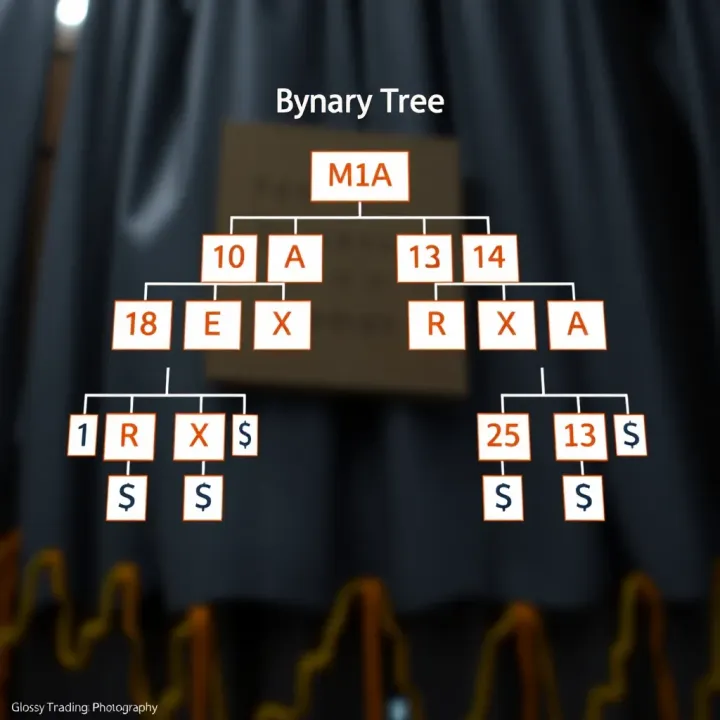
Understanding Binary Tree Height and Its Importance
🌳 Learn how to find the maximum height of a binary tree, its impact on performance, and tips to optimize tree operations for coding success.
Edited By
Thomas Wilson
Binary trees are fundamental structures in computer science, serving as building blocks for various algorithms and data processing tasks. Traversing a binary tree means visiting each node in a specific order, which affects how data is read or manipulated. That said, understanding the standard traversal methods—preorder, inorder, and postorder—is essential for anyone working in programming, trading algorithms, or data analysis.
Each traversal technique visits nodes in a unique sequence, influencing the outcome of operations like searching, sorting, or expression evaluation. For example, inorder traversal reads nodes in a sorted sequence for binary search trees, making it invaluable for data retrieval tasks. Likewise, preorder traversal is useful for copying or serialising the tree structure.

Traversing binary trees efficiently can make a significant difference in algorithm performance, especially when dealing with large datasets or real-time processing.
Here's a quick breakdown of the three primary traversal methods:
Preorder Traversal: Visit the root node first, then recursively traverse the left subtree, followed by the right subtree.
Inorder Traversal: Traverse the left subtree first, visit the root node next, then the right subtree. This method returns nodes in non-decreasing order for binary search trees.
Postorder Traversal: Traverse the left subtree followed by the right subtree, and visit the root node last. It's commonly used in deleting trees or evaluating postfix expressions.
Besides these, level-order traversal (or breadth-first traversal) visits nodes layer by layer from top to bottom, which proves practical in scenarios such as shortest path algorithms or scheduling tasks.
Understanding these traversal methods not only helps in implementing tree-based algorithms but also in optimising tasks like parsing mathematical expressions, managing hierarchical databases, or analysing complex trading models. Subsequent sections will cover each traversal in detail, along with practical examples and efficient implementation tips to help you apply these concepts effectively.
Binary tree traversal forms the backbone of many computer science tasks, especially when dealing with hierarchical data. Traders analysing decision trees or educators explaining recursive structures find it essential to understand how to navigate every node systematically. Traversing a binary tree lets you visit each element in an organised manner, which helps in tasks such as searching, sorting, and expression evaluation.
Understanding traversal is not just academic; it has practical benefits. For example, investment algorithms often represent decision processes as binary trees, and traversing them efficiently improves computation speed. Similarly, in data processing systems, traversals help extract or modify data stored in tree-like structures.
A binary tree is a hierarchical structure where each node can have at most two children, often called the left and right child. This simple constraint creates a flexible yet powerful framework for organising data. Picture a family tree where each person can have up to two children – this is quite similar in concept.
Practically, the binary tree's structure allows efficient operations such as insertions and deletions in architecture like binary search trees (BSTs). For instance, stock market analysis platforms use BSTs to keep trade data sorted, speeding up lookups.
The tree's root is the topmost node from where all branching begins, similar to a company CEO at the top of an organisational chart. Each node represents an element containing data and pointers to its children. Leaves are nodes without children, much like employees without subordinates.
Knowing these terms is crucial, as algorithms often refer to nodes based on these roles. For example, traversals may start at the root and visit every node down to the leaves, depending on use cases like evaluating expressions or printing all elements.
Binary trees underlie many complex data structures, including heaps and tries used in real-world applications such as priority queues in high-frequency trading or autocomplete features in search engines. Their ability to balance depth and breadth efficiently reduces processing time and memory usage compared to flat data arrays.
Furthermore, their recursive nature makes them ideal for divide-and-conquer algorithms frequently used in data analytics and algorithm design.
Tree traversal is the process of visiting all nodes in a binary tree exactly once, in a systematic order. This helps in accessing or modifying each element. Without traversal, the vast data stored in trees remains inaccessible because one cannot just jump from one node to another randomly.
For example, in portfolio management software, traversing decision trees assists in evaluating investment outcomes by sequentially processing nodes representing various factors.
There are primarily two types of binary tree traversals: depth-first and breadth-first. Depth-first traversals (inorder, preorder, postorder) dive deep into one branch before backtracking, which is useful in scenarios like syntax tree evaluations or sorting. Breadth-first traversal (also called level order) explores nodes level by level, helping in scenarios such as the shortest path calculations or network broadcasting.
Each traversal type suits specific applications, and understanding their differences allows you to choose the best one for your algorithm or data processing task.
Traversal methods turn a complex binary tree into a manageable sequence, enabling efficient computation and analysis across many fields, from finance to education.

Understanding the different types of binary tree traversal methods is fundamental to efficiently processing tree data structures. Each technique follows a specific order for visiting nodes, impacting the way data is accessed and manipulated. These traversal methods help in tasks like searching, sorting, and representing hierarchical relationships clearly.
Inorder traversal visits nodes starting from the left subtree, then the root, and finally the right subtree. This method is particularly handy for binary search trees (BSTs) because it visits nodes in ascending order. For example, performing an inorder traversal on a BST of stock prices arranged by date gives you the prices chronologically—very useful for analysing trends or preparing data for further computation.
Preorder traversal visits the root node first, followed by the left and right subtrees. This method is commonly used to create a copy of the tree or to evaluate prefix expressions if the tree represents an expression. In algorithm design, it helps track the structure itself, capturing the visiting sequence of each node before its descendants.
Postorder traversal processes the left and right subtrees before the root node. It is practical when you need to delete or free nodes in a tree safely, as children are handled before their parent. For instance, postorder traversal finds use in expression tree evaluation, where computation proceeds from operands (leaves) to the operator (root), ensuring correct order of operations.
Level order traversal concept explores the tree level by level, visiting all nodes at a particular depth before moving deeper. This method maps naturally to scenarios like organisational charts or network routing, where processing nodes in layers is necessary. For example, in a job scheduling system, level order traversal could help assign tasks based on their priority or dependency level.
Queue-based implementation is the typical way to achieve level order traversal. The queue maintains nodes of each level, ensuring they are processed in the right order. This approach scales efficiently, making it suitable for large datasets. For example, when handling customer queries in a call centre system modelled as a tree, queues ensure first-come, first-served processing across service levels.
Selecting the right traversal method depends on your data structure and the problem at hand. Whether it's inorder for sorted access or level order for breadth-wise scanning, understanding these techniques equips you to write better, more efficient algorithms.
Depth-first techniques focus on exploring as far down a branch before backtracking.
Breadth-first methods prioritise visiting all neighbours before deeper levels.
Properly using binary tree traversal methods enhances data handling, be it in markets, data science, or software design tailored for Indian tech ecosystems.
Understanding how to implement binary tree traversal algorithms is fundamental for anyone working with data structures or algorithms. Traversal algorithms allow you to systematically visit each node of a tree, which is necessary for tasks like searching, sorting, and modifying tree data efficiently. Implementing these algorithms correctly ensures your programs run smoothly and handle trees of various sizes without unexpected failures.
Recursive logic fits naturally with depth-first traversals like inorder, preorder, and postorder. The idea is to break the problem down: for example, during an inorder traversal, you recursively visit the left subtree, process the current node, and then visit the right subtree. This mirrors how trees are defined, making the code easier to read and write.
Recursion is especially practical when the tree size isn’t huge, as it simplifies the implementation. However, recursive calls add overhead and can lead to stack overflow for deep trees. So while recursion often helps beginners understand traversal flow, it may not be the best choice in performance-sensitive or memory-limited scenarios.
Recursive implementations make traversal algorithms quite concise and intuitive, helping programmers visualise the logic clearly. For example, writing a preorder traversal recursively usually takes just a handful of lines. Such implementations match the mathematical or conceptual definition of tree traversal closely.
On the flip side, recursion depends on the call stack, and if the tree height grows deep (imagine a skewed tree with thousands of nodes), this might trigger stack overflow errors. Moreover, recursive calls add overhead since each call allocates some stack space. Thus, for large data or systems with limited memory, iterative methods often offer more reliable performance.
Using stacks for depth-first traversals mimics the behaviour of recursive calls manually. Instead of relying on the system stack, you explicitly push and pop nodes on your own stack structure. Take inorder traversal: you keep moving left, pushing nodes until no more left children exist. Then you process nodes by popping from the stack and shifting right, repeating the process.
This approach suits applications where control over memory is vital and recursion depth might hit limits. It also helps in environments that discourage or disallow recursion. Although the code is a bit more complex than recursion, it prevents the risk of stack overflow and often runs faster due to lesser overhead.
Handling breadth-first traversal iteratively is usually done with a queue instead of a stack. The idea is straightforward: you enqueue the root node first, then dequeue nodes one by one, enqueueing their children in order. This ensures nodes are processed level by level, which is the hallmark of breadth-first traversal.
Queues work well for level order traversal tasks like shortest path algorithms in graphs or processing hierarchical data layerwise. The iterative queue-based method is the standard practice, avoiding complex recursion and offering predictable memory usage compared to depth-first recursive stacks.
Both recursive and iterative traversal implementations have their place. For shallow trees and simplicity, recursion is elegant. For big trees or performance-critical systems, iterative methods using stacks or queues provide better control and reliability.
Binary tree traversals are more than just academic exercises; they play a vital role in practical computing tasks like data processing, sorting, and searching. Understanding their applications helps traders, analysts, educators, and enthusiasts tap into efficient algorithms for managing complex datasets.
Inorder traversal visits nodes in a binary search tree (BST) in ascending order. This makes it especially useful for retrieving sorted data without additional sorting steps. For example, when working with financial data sorted by dates or stock prices, an inorder traversal can quickly extract data in increasing order, saving time and computational resources.
Expression trees represent arithmetic expressions where leaves are operands and internal nodes are operators. Postorder traversal is typically used to evaluate these trees, but inorder traversal helps reconstruct the original expression with correct operator precedence. This application shines in calculators and compiler design, where expressions need parsing and evaluation efficiently.
Preorder traversal is handy for copying or saving the structure of a tree because it visits nodes before their children. While postorder traversal, which visits children before the node, is often used in deleting trees or evaluating dependencies in complex task flows. For instance, software that manages project task dependencies can use postorder traversal to ensure all prerequisites are completed before moving forward.
Level order traversal, visiting nodes level by level using a queue, resembles the breadth-first search (BFS) approach. This makes it valuable in shortest path computations on trees and graphs, such as routing algorithms or network broadcasting. When analysing social networks or supply chains, level order traversal helps identify the quickest path or minimal hops between nodes.
Using the appropriate traversal method streamlines data handling, whether sorting stock records, evaluating mathematical expressions, or finding efficient paths in complex networks.
Each traversal technique brings its own strengths to real-world applications, making the theoretical concepts highly relevant for practical problem-solving in today's data-driven fields.
Handling binary trees, especially large ones, presents certain challenges in traversal that directly affect performance, memory use, and practicality. Optimising these aspects helps developers avoid bottlenecks and enhances algorithm efficiency for real-world applications.
When dealing with large binary trees, memory consumption becomes a key concern. Each node requires storage not just for data, but for pointers to child nodes. This adds up quickly; for example, a tree with 10 lakh nodes will demand considerable memory just to hold its structure. Moreover, traversal algorithms often use additional data structures like stacks or queues which further increase memory use.
For instance, in a level-order (breadth-first) traversal, a queue may hold an entire level’s nodes at once. In very deep or wide trees, these queues could consume substantial memory. Hence, understanding tree size and shape can guide whether to use traversal methods that minimise memory, such as depth-first traversals that rely on recursion or limited stack usage.
Recursive approaches frequently implement depth-first traversals. While clean and easy to understand, they risk stack overflow with very deep trees due to excessive recursive calls. Tail recursion can help: it's a specific form where the recursive call is the last operation, allowing some compilers or interpreters to optimise and reuse stack frames.
However, many languages used in practical Indian software projects like Python or Java do not guarantee tail call optimisation. As a result, traversing skewed trees (where one branch extends deep) can crash programs with stack overflow errors. To avoid this, iterative methods using explicit stacks or converting tail recursion to loops prove more robust for large, deep trees.
Most binary tree traversals — inorder, preorder, postorder, and level order — touch every node once. Hence, their time complexity normally sits at O(n), where n is the number of nodes. This reflects a linear relationship: doubling nodes roughly doubles the traversal time.
Yet, real performance depends on tree shape and traversal method. Balanced trees allow quicker access to nodes, while skewed trees might degrade cache performance and increase overhead. For example, recursive traversal on a balanced tree often performs more efficiently than on a highly unbalanced one.
Optimising traversal means reducing extra memory while maintaining time efficiency. Iterative traversals using a stack instead of recursion save risk of stack overflow and improve control over memory.
In level order traversal, using linked lists or ring buffers instead of simple queues can reduce overhead. Apart from data structures, memoisation techniques help avoid repeated computations in certain tree processing tasks.
In the Indian context, where applications might run on resource-constrained devices or process huge data, careful choice of traversal method and optimisation becomes critical. For instance, when handling massive customer datasets in financial apps, an iterative inorder traversal using a well-managed stack ensures stability while retaining speed.
Efficient binary tree traversal in large datasets is often about balancing memory use and processing time, tailored to the tree’s structure and application environment.
Understanding these challenges and strategies equips developers with practical knowledge to implement scalable and performant tree algorithms.
🌳 Learn how to find the maximum height of a binary tree, its impact on performance, and tips to optimize tree operations for coding success.

Learn how to insert, search, and delete nodes in a Binary Search Tree🌳. Explore traversal methods, balancing techniques, and real-life applications for efficient data handling.

🔍 Explore how linear and binary search differ in speed, data needs, and real-world use cases to choose the right method for efficient searching.

Explore how to calculate the 🎄 maximum height of a binary tree using recursive and iterative methods. Understand its role in algorithms and data structures for efficient computing 📊.
Based on 15 reviews