
Understanding the Optimal Binary Search Tree Algorithm
📚 Explore the optimal binary search tree algorithm 🧠 that reduces search costs using probabilities, dynamic programming, and improves efficiency in real-world tasks.
Edited By
Benjamin Clark
Binary to text decoders form the backbone of digital communication by translating sequences of 0s and 1s into understandable characters. Whether you’re analysing stock data feeds or sending messages through chat apps on your mobile, these decoders ensure that raw binary signals convert into meaningful text.
At its core, binary code represents data using two symbols—zero and one. Each combination corresponds to a particular character or instruction. The decoder reads these patterns and maps them to alphabets, numbers, or symbols. For instance, the binary sequence 01000001 corresponds to the letter ‘A’ in ASCII (American Standard Code for Information Interchange).
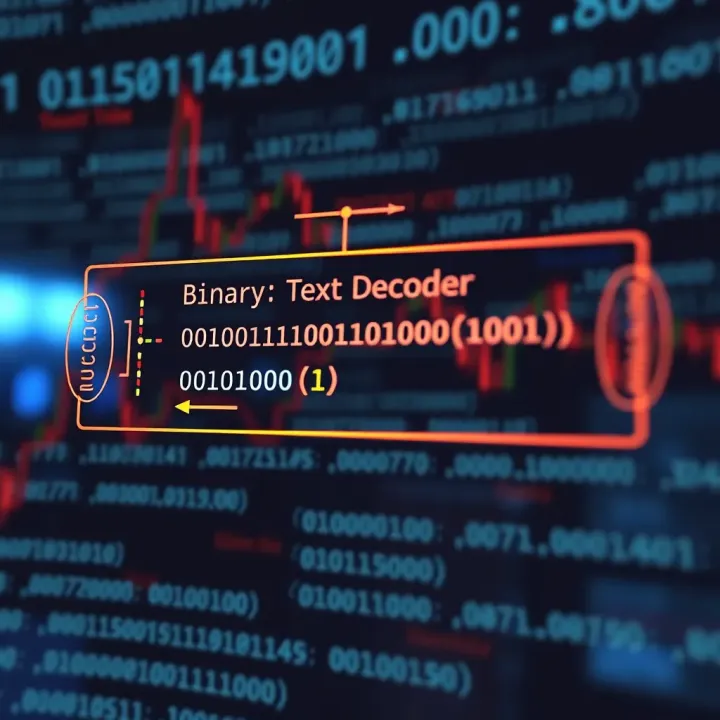
Decoding methods vary depending on the encoding standard used. Common schemes include ASCII, Unicode, and UTF-8. ASCII suits simple English text, while Unicode and UTF-8 handle diverse languages, including Indic scripts like Hindi and Tamil. This difference matters a lot in India’s multilingual context, where proper decoding ensures messages show up accurately on devices.
Inadequate decoding often causes scrambled text or question marks on screen, a common issue when files move between systems using different encoding.
Binary to text decoders are implemented in software libraries, hardware interfaces, and online tools. Traders and analysts dealing with rapid data streams from exchanges may rely on custom decoders embedded in their applications. Educators teaching computer science use decoding examples to demonstrate how digital data shapes communication and storage.
Common challenges include handling corrupted data, synchronising transmissions, and recognising the correct encoding format. If the decoder misinterprets the pattern, it can lead to illegible output, which might impact a professional’s decision-making.
Understanding these decoders helps you troubleshoot communication glitches and design better systems. The technology itself is not limited to computers but extends to IoT devices, SMS, and even satellite data reception, making it relevant to diverse fields.
This article breaks down how binary to text decoders work and explores practical applications tailored for the Indian environment, offering insights on tools and tips for smoother decoding experiences.
Understanding the basics of binary and text encoding is key to grasping how data moves across digital platforms, especially for traders, analysts, and educators who deal with large volumes of information daily. Binary, the language of computers, is the foundation upon which all digital text and data are built. Without a clear knowledge of how text translates into binary and vice versa, decoding efforts can misfire, leading to errors and data loss.
Definition of binary code: Binary code refers to a system of representing information using only two symbols, typically 0 and 1. Each 0 or 1 is called a bit—the smallest unit of data in computing. This simple on/off scheme matches how electronic devices process signals, making it the backbone of all computer operations.
For instance, when you type a message on your phone or computer, the characters get converted into a sequence of bits which the device understands as instructions or readable text. This conversion is essential because computers do not interpret letters or words directly—they only understand these binary sequences.
Use of bits and bytes in computing: Bits are grouped into sets of eight, known as bytes. A single byte can represent up to 256 different values, enough to encode a single character in many text standards like ASCII. For example, the letter "A" in ASCII is represented by the byte 01000001.
Bytes are the basic building blocks for larger data structures, files, and applications. When trading software receives stock price updates, it reads binary data packed in bytes and then decodes it into the familiar numbers and text you see on the screen.
ASCII and Unicode standards: ASCII (American Standard Code for Information Interchange) was one of the earliest encoding standards, assigning numerical values to English alphabet letters, digits, and symbols, each fitting within one byte. While ASCII covers English alphabets well, it falls short for global languages.
Unicode was developed to overcome this limitation, supporting a vast range of scripts including Hindi, Tamil, and other Indian languages. Unicode uses more bytes per character, offering a consistent way to represent text from multiple languages in the same document or software.
For example, the Devanagari character 'अ' has a unique Unicode code point, allowing software to display it correctly irrespective of the device or platform.
Encoding schemes used in India: In India, Unicode has become the preferred standard, especially with the rise of digital content in multiple regional languages. Earlier, schemes like ISCII (Indian Script Code for Information Interchange) were used to encode Indian scripts but lacked universal support.
Unicode allows Indian websites, educational tools, and apps to support languages like Hindi, Bengali, Tamil, and Marathi seamlessly. This ensures messages, documents, and trading platforms operate smoothly without garbled or unreadable text, which is critical when dealing with financial data or official communication.
A solid grasp of binary data and text encoding standards gives you the tools to decode digital information correctly, paving the way for smooth data exchange and error-free communication in any Indian or global context.

Binary to text decoders play a key role in converting raw digital data into readable language, which is essential for communication and computing. These decoders interpret binary sequences—made up of 0s and 1s—and translate them into characters that humans can understand, such as letters, numbers, and symbols. Understanding how this process works helps traders, analysts, and educators appreciate the underlying mechanisms behind data exchange, text processing, and programming.
Converting bits to characters involves grouping binary digits (bits) into fixed-length sequences that correspond to specific characters. For example, in the ASCII (American Standard Code for Information Interchange) encoding system, each character is represented by 7 or 8 bits. So the binary sequence 01000001 translates directly to the character 'A'. This conversion is the foundation of text decoding, allowing systems to display readable text from binary data streams.
The practical use of this process is clear in areas like networking and data files, where large binary files need to be interpreted accurately. For instance, decoding binary-encoded transaction data in stock trading platforms ensures clarity in reports and communication.
Role of character encoding tables is crucial in this process. These tables act as a reference dictionary mapping each binary sequence to its corresponding character. Unicode, for example, provides a comprehensive encoding table that supports characters from many languages, including Indian scripts like Devanagari, Tamil, and Bengali. Without these tables, decoding could produce meaningless output or garbled text.
Thanks to encoding tables, software can flexibly convert the same binary input into different languages or symbol sets by changing the reference table. This ability is vital for Indian users dealing with multilingual texts in digital formats.
Direct conversion is the simplest decoding approach where each binary group directly maps to a character via its numeric value. This method is fast and efficient, ideal for straightforward text encodings like ASCII. One practical benefit is its low computational overhead, which suits devices with limited processing power, such as embedded systems or older mobile phones common in rural India.
Use of lookup tables takes direct conversion a step further. Instead of calculating character values on the fly, lookup tables store preset associations between binary patterns and characters. This is particularly useful for complex encodings like Unicode's UTF-8, where characters can vary in length. Lookup tables speed up decoding by avoiding repeated calculations, making real-time communication and streaming smoother.
Handling different text encodings is a common challenge, as multiple encoding standards exist worldwide. In India, for example, UTF-8 and UTF-16 are common for supporting regional scripts, while ASCII remains popular for English text. Decoders identify the encoding format—either through metadata or heuristics—before applying the appropriate method. Proper handling ensures that texts don’t appear as jumbled characters, which is essential for applications like online banking or government e-services where accuracy matters a lot.
Accurate binary to text decoding depends not just on converting bits but also on understanding the encoding format and using the correct tables. Missing this step can lead to misinterpretation and data errors.
In summary, binary to text decoders work by grouping bits into characters and referring to encoding tables to map those bits correctly. Depending on the scenario, decoders use direct conversion or lookup tables and adjust for different encoding systems. These methods ensure that digital data communicates clearly across devices, languages, and applications, making them indispensable in today’s data-driven world.
Tools and software play a significant role in simplifying the process of converting binary data into readable text. Without these utilities, the decoding task could get tedious and prone to errors, especially with complex or large datasets. They provide accuracy, convenience, and speed, which are essential whether you're debugging code, analysing network traffic, or simply learning about data formats.
User-friendly interfaces are one of the biggest advantages of web-based binary to text decoders. These tools usually present a clean layout where you can simply paste binary code or upload a file, then get the decoded text instantly. For users who don't want to install extra software or fiddle with programming libraries, this ease of use makes decoding accessible to anyone. Even those new to computing can grasp the operations without steep learning curves.
Popular web-based decoders include sites like RapidTables and Browserling, which support various encoding standards such as ASCII, UTF-8, and Unicode. These platforms handle everything on the cloud, so you don’t need powerful hardware or specialised setup. Moreover, Indian users can benefit from these tools during tasks like checking data exports or logs from local software, where direct access to decoding software might be limited.
Software for Windows, Linux, and Android offers more flexibility and offline access. Windows tools like HxD and Notepad++ with binary plugins allow detailed editing and analysis of binary files. Linux users often rely on built-in commands or powerful editors like Vim with customised scripts. On Android, apps like "Binary Converter" enable decoding on the go—handy for developers or students in tier-2 cities with intermittent internet access.
Integration with programming environments is crucial for developers and analysts working on data-heavy projects. Tools that plug into IDEs like Visual Studio Code or PyCharm let you convert binary data directly within your coding workflow. This tight integration saves time and reduces errors, especially when working with protocols or large log files. Additionally, scripting languages like Python offer libraries (e.g., binascii) that automate decoding tasks, providing a programmable approach for customised needs.
Whether online or offline, choosing the right decoding tool depends on your workflow, data size, and encoding type. For occasional quick checks, web tools suffice, but deeper analysis demands software with advanced features and integration.
Understanding these tool options helps traders, investors, educators, and enthusiasts alike to handle binary data efficiently and avoid common mistakes during decoding.
Binary to text decoders find their value in many practical scenarios where raw data must be translated into comprehensible information. They bridge the gap between machine-level binary data and human-readable text, which is critical in areas such as communication networks and software development. Understanding these applications helps traders, analysts, educators, and enthusiasts appreciate how decoding aids smooth data flow and debugging.
Interpreting data packets is a core use of binary to text decoders. Data packets in networks transmit information in binary form, including headers, payloads, and protocols. Decoders convert these bits into text so network engineers can examine messages, detect errors, and monitor traffic. For example, when analysing TCP/IP packets, decoding the binary payload reveals the actual content exchanged between devices, useful in both troubleshooting and security monitoring.
Decoding messages that follow specific network protocols also relies heavily on these decoders. Protocols like HTTP, FTP, and SMTP encode commands and responses in binary. Without decoding, it would be impossible to read or analyse these communications. This is especially relevant for monitoring data transfers during online stock trades or digital transactions, where understanding protocol exchanges can prevent mishaps or delays.
Debugging binary data becomes simpler with binary to text decoding. Programmers frequently deal with binary dumps or device firmware logs, which aren’t human-friendly until decoded. Decoders translate this data into readable text, allowing programmers to spot bugs in software or hardware interactions quickly. For instance, embedded software developers use decoding to identify issues in sensor data streams or memory contents.
Working with encoded files is another practical use. Many data files—like documents, images, or compressed archives—store content in encoded binary formats. Decoding these files reveals their contents for analysis or conversion. This becomes vital when recovering corrupted files, verifying transmitted documents, or analysing data exports from systems like banking software or logistics applications widely used in Indian enterprises.
Accurate binary to text decoding supports clearer communication between machines and humans, ensuring data integrity, security, and usability across sectors.
Helps network specialists monitor and troubleshoot effectively
Enables programmers to decode raw data for efficient debugging
Allows data analysts to extract meaningful content from encoded files
These practical applications show why decoding is essential beyond just academic interest—it powers real-world systems from stock exchanges to telecom networks and software across India and beyond.
Binary to text decoding seems straightforward at times, but it often runs into hurdles that can mess up data interpretation. Understanding these challenges helps traders, analysts, and developers troubleshoot properly and improves the overall reliability of decoding processes. When data doesn't decode correctly, the consequences range from minor glitches to serious miscommunication, especially in financial tech and automated trading systems where every bit counts.
Incorrect encoding assumptions arise when the decoder expects a certain character set, such as ASCII, but receives data encoded in Unicode or another scheme. This mismatch leads to garbled text or unreadable characters. For example, a report from a multinational asset management firm might appear scrambled if it mistakes UTF-8 encoded data for ISO-8859-1. Since India uses multiple languages with varied scripts, software working with regional data may fail without the right encoding knowledge.
Misreading encoding also often happens while handling files generated by different tools. Suppose a bulk email application exports contact data in UTF-16 but the recipient’s system decodes it assuming ASCII. The resulting output is nonsense characters, creating confusion and extra workload to reprocess the file.
Loss of data integrity means the original binary information suffers corruption during transmission, storage, or conversion. This typically happens due to network errors, faulty storage devices, or interference in communication channels. Imagine a stock exchange message transmitted over a shaky connection where bits flip inadvertently. The decoder might produce wrong prices or order details, affecting decisions and trades.
On the software side, improper handling of datatype sizes during conversion can strip off leading zeros or truncate bits, disturbing the intended meaning. In scenarios like financial data processing or regulatory reporting, such data loss spells trouble, affecting audits and compliance.
Verifying encoding format before decoding is key to accuracy. Always check the metadata or headers that specify encoding standards, especially when dealing with files from unknown or external sources. This precaution prevents incorrect assumptions and thus avoids misinterpretation.
In practice, tools like Notepad++ or integrated development environments (IDEs) often reveal file encoding upfront. For instance, confirming UTF-8 for a CSV file containing client details ensures the data reads correctly in Indian languages like Tamil or Hindi. Validation here saves substantial time from back-and-forth corrections.
Using reliable tools and methods makes decoding less error-prone. Prefer software verified for dealing with multiple encodings and offer options to specify or auto-detect the encoding type. For example, open-source libraries like ICU (International Components for Unicode) handle various scripts and can be integrated into in-house applications.
Besides software, adopting standards recommended by bodies like SEBI or RBI when transmitting financial data guarantees consistency; since regulators emphasise formats and validations, staying aligned reduces risk. Also, periodically updating decoding tools keeps pace with new encoding standards and security patches, safeguarding data integrity.
Good practice: Always cross-check decoding results with sample inputs and expected outputs before deploying tools in critical systems.
By understanding these common issues and following simple yet effective tips, you can significantly reduce errors in binary to text decoding. This confidence helps maintain smooth operations in domains where data accuracy means tangible business value.
📚 Explore the optimal binary search tree algorithm 🧠 that reduces search costs using probabilities, dynamic programming, and improves efficiency in real-world tasks.
Explore how numbers work in binary form 💻 Learn basic principles, conversion methods, arithmetic operations, and real-world uses, ideal for tech enthusiasts in India 🇮🇳

Explore linear and binary search algorithms 🔍 Understand their techniques, differences, efficiency, and applications to pick the right method for your data.
Learn how to convert octal numbers to binary easily with step-by-step methods, real examples, common pitfalls to avoid, and handy tips 🔢💡
Based on 15 reviews