
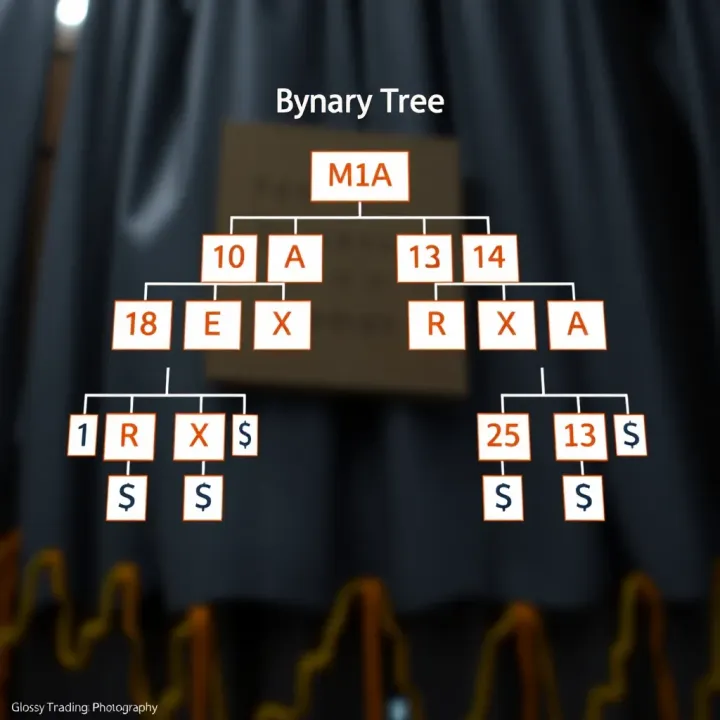
Understanding Binary Tree Height and Its Importance
🌳 Learn how to find the maximum height of a binary tree, its impact on performance, and tips to optimize tree operations for coding success.
Edited By
Isabella Clarke
Binary tree traversal is a key operation in computer science that involves visiting every node in a binary tree in a specific order. This process is essential for many applications, such as searching data efficiently, sorting elements, and creating or modifying tree structures. By understanding traversal methods, programmers can manipulate hierarchical data with ease and reliability.
There are three primary traversal methods for binary trees: inorder, preorder, and postorder. Each follows a distinct sequence to visit nodes and serves different practical purposes depending on the task.

Inorder Traversal: Visits the left subtree first, then the root node, and finally the right subtree. This method produces sorted output for binary search trees, making it valuable for tasks like sorting or retrieving sorted data.
Preorder Traversal: Processes the root node before its subtrees. It’s commonly used to create a copy of the tree or to save its structure because it records parent nodes before children.
Postorder Traversal: Visits child nodes before the parent node. This is handy for deleting the tree or evaluating expressions in expression trees.
Each traversal method offers a different perspective of the tree, making them suited to specific operations in algorithms or data handling.
Apart from these depth-first traversals, level-order traversal explores nodes level by level, which is useful in scenarios like network broadcasting or shortest path algorithms.
Implementation of these traversals can be done recursively, leveraging the natural tree hierarchy for concise code, or iteratively using stacks or queues to manage nodes explicitly. Choosing between recursive and iterative methods depends on factors like memory constraints and ease of understanding.
For example, recursive inorder traversal in a binary search tree (BST) helps list numbers in ascending order, which is invaluable when dealing with sorted data in finance or analytics. On the other hand, preorder traversal assists when reconstructing a tree from data received during communication between distributed databases.
Understanding these traversal types and their implementation techniques prepares software developers, educators, and data analysts to apply tree structures effectively in real-world applications, leading to more efficient data processing and problem-solving.
Understanding the binary tree structure lays the foundation for exploring traversal methods. Binary trees organise data hierarchically, enabling efficient searching, insertion, and deletion operations common in programming and database management.
Every binary tree consists of nodes, the fundamental units holding data. The topmost node is the root, from which all other nodes descend. Nodes without children are called leaf nodes; they represent endpoints with no further branches. Child nodes refer to nodes directly connected below a parent node, classified as left or right child based on their position. For instance, in a stock market portfolio tree, the root can represent the entire portfolio, child nodes represent asset classes, and leaf nodes detail individual stocks.
Each node divides the tree into two parts: the left and the right subtree. These subtrees themselves are binary trees, which simplifies recursive processing. In practical terms, consider a family tree where the left subtree might represent paternal lineage and the right subtree maternal lineage. Understanding these subtrees helps in targeted operations like balancing or searching specific branches.
Height measures the longest path from a node down to a leaf, while depth is the distance from the root to the node. For example, in organisational charts, the CEO sits at depth zero. Managers below are at increasing depths, with height indicating levels beneath any node. These metrics are vital in analysing tree performance, as deeper trees may cause slower searches and require optimised traversal approaches.
Traversal defines the systematic way of visiting all nodes in a tree to process or retrieve data. Without traversal, extracting meaningful information from the binary tree becomes impossible. For example, to list all user account details stored in a binary tree database, traversal ensures every node is accessed exactly once.
Tree traversal underpins many algorithms such as expression evaluation, sorting, and searching. Consider a compiler interpreting an expression tree; it uses postorder traversal to compute results correctly. Traversals also assist in generating hierarchical reports, managing file systems, and network routing where trees model connectivity.
Efficient traversal of binary trees directly impacts the speed and reliability of software systems that depend on structured data management.
By grasping these core concepts, you will be better equipped to understand the traversal techniques and their subtle differences covered in upcoming sections.
Binary tree traversals are essential for visiting every node in a tree systematically. Knowing the different types helps programmers choose the right approach for tasks like searching, sorting, or manipulating data. Each traversal method follows a specific order, influencing how the tree’s information is processed and applied.

Definition and visiting order: Inorder traversal visits nodes in the left subtree first, then the root, and finally the right subtree. This pattern — left, root, right — means it processes tree nodes in ascending order if the tree is a binary search tree (BST). For example, traversing a BST holding stock prices will yield those prices sorted from lowest to highest.
Use cases and examples: Inorder traversal is widely used when sorted data retrieval is the goal. In a BST representing company revenues, an inorder traversal lists the revenues in increasing order, helping analysts quickly understand trends. It also supports tasks like validating BST properties or performing range queries.
Process explanation: Preorder traversal visits the root node first, then the left subtree, followed by the right subtree. This order prioritises the root, making it useful to copy or serialize structures since the root’s information appears before its children.
Where preorder traversal is useful: In applications where recreating the exact tree is necessary, such as storing a decision tree model, preorder traversal provides a natural way to save or transmit the tree structure. It's also handy in scenarios like generating prefix expressions in arithmetic evaluations.
Traversal pattern: Postorder traversal visits the left subtree, then the right subtree, and finally the root node. This method ensures child nodes are processed before their parent, which suits situations where cleanup or deletion starts from the bottom.
Practical uses in programming: Postorder is commonly used in compilers to evaluate expression trees. For instance, computing the value of a mathematical expression stored in a binary tree often relies on postorder traversal. It's also effective for safely deleting nodes in a tree, as children are removed before their parents.
Concept and implementation: Level order traversal, or breadth-first traversal, visits nodes level by level from top to bottom, left to right. It uses a queue to manage the order, unlike the depth-first nature of previous types.
Applications in real-world problems: This traversal fits perfectly where the hierarchy matters, such as organisational charts or network broadcasting. For example, in social media graphs or communication networks, level order traversal helps process nodes in layers, simulating message propagation stages.
Understanding these traversal types lets developers select suitable methods for data retrieval, processing, and manipulation based on their specific requirements and the tree’s structure.
Implementing binary tree traversals allows programmers and analysts to visit each node of a tree in an organised way, enabling various computations and data retrievals. In practical terms, these traversals support tasks such as searching for a value, printing tree contents in a certain order, or even transforming tree data for other algorithms. Understanding how to implement these traversals efficiently is key for anyone working with hierarchical data structures.
Recursion is a natural fit for tree traversal because a binary tree itself has a recursive structure—each node branches into subtrees that resemble the same kind of tree. The recursive approach breaks down the traversal task into smaller problems: process the current node, then recursively traverse its left and right subtrees. For example, in an inorder traversal, the function calls itself first on the left child, then processes the current node, and finally recurses on the right child.
This method leads to clean and readable code, as it directly mirrors the conceptual tree traversal. However, the recursive approach carries the risk of stack overflow if the tree is very deep. Also, debugging recursion can sometimes be tricky for those less familiar with it.
The biggest advantage of recursion is simplicity. In just a few lines, you can implement traversals that handle complex tree structures without explicit loops or external data structures. This helps developers focus on the traversal logic rather than bookkeeping details.
On the downside, recursion uses additional memory for the call stack proportional to the tree height. For skewed trees, this can become significant. Moreover, in environments where stack size is limited, this may cause crashes or inefficient performance. Hence, while recursive traversal is elegant, it isn't always practical for very large or unbalanced trees.
Iterative methods avoid recursion by using explicit data structures like stacks and queues. For inorder, preorder, and postorder traversals, a stack helps keep track of nodes yet to be processed. For instance, iterative inorder traversal uses a stack to simulate the recursive call stack, systematically pushing and popping nodes to visit them in the correct order.
Postorder traversal is trickier to implement iteratively but can be done using two stacks or by marking visited nodes. The iterative approach is beneficial in scenarios where recursion depth could be a problem or when optimising stack memory.
For level order traversal, a queue is the natural data structure. This traversal visits nodes level by level from top to bottom. Using a queue, nodes are enqueued as their parents are processed, ensuring the correct visit order without recursion. This method is especially useful in algorithms related to breadth-first search or processing nodes in layers.
Iterative solutions generally use more explicit control of data structures and may require longer code but avoid the pitfalls of deep recursion. Recursive code tends to be shorter and closer to the conceptual explanation but can hit limits with large trees.
Choosing between iterative and recursive methods depends on the tree size, environment constraints, and developer preference. Iterative methods offer greater control and reduced risk of stack overflow, while recursion provides clarity and quick implementation for smaller trees. Both approaches are essential tools for a well-rounded programmer working with binary trees.
Implementing tree traversals both recursively and iteratively equips you to handle a variety of practical scenarios—from coding interviews to real-world data processing—efficiently and reliably.
Understanding performance and complexity is key when working with binary tree traversals. It helps in selecting the right traversal method based on efficiency, especially in large data sets where time and memory use can significantly affect application performance. Knowing the costs tied to each traversal gives practical insight into algorithm choice and optimisation.
All four standard binary tree traversals — inorder, preorder, postorder, and level order — generally run in O(n) time, where n is the number of nodes. This means each node is visited once, making these traversals efficient for processing the entire tree. For instance, in a binary search tree (BST) with 1 lakh nodes, performing an inorder traversal still requires checking all nodes, so time scales linearly.
That said, the shape of the tree affects performance too. A balanced tree offers consistent O(n) visits with short paths between nodes. Meanwhile, skewed trees (like a linear chain) still take O(n) time, but the traversal depth increases, potentially impacting recursive calls or stack usage. Such imbalances can slow down operations relying on traversal due to deeper recursive calls or more extensive queue management.
Recursive traversal methods demand extra stack space proportional to the tree's height. For balanced trees, this height is about log₂n, so stack usage grows slowly with more nodes. However, in skewed trees, stack depth can hit n, leading to higher memory consumption and possible stack overflow. Consider a BST that transforms into a linked list—recursive traversals then involve deep call stacks.
Iterative methods swap recursion for explicit stacks or queues. Using a stack for inorder, preorder, or postorder traversal typically requires space up to O(h), where h is the tree height, similar to recursion. Level order traversal uses a queue that can hold nodes across a tree level, potentially up to O(n/2) in a balanced tree's lowest level. These structures keep traversal in check, preventing excessive call stack depth and often offering better control and debugging ease.
Choosing between recursive and iterative traversal affects both time and memory. In systems with limited stack size, iterative methods can prevent failures caused by deep recursion.
Overall, understanding the time and space complexities helps in designing traversal routines that suit your application's data patterns and resource constraints, making your code more robust and efficient.
Binary tree traversals prove essential in programming tasks involving structured data management. Traversing nodes in a specific order helps solve problems like searching, sorting, evaluating expressions, copying, and deleting trees efficiently. These traversal methods form the backbone of many algorithms developers rely on daily.
Binary search trees and traversal roles: Binary Search Trees (BSTs) keep data sorted to allow fast search, insertion, and deletion. In BSTs, inorder traversal visits nodes in ascending order, making it the go-to method for retrieving sorted data. For example, if you want to print all names in alphabetical order stored in a BST, inorder traversal does the trick without additional sorting.
This traversal order leverages the BST property where left child nodes hold smaller values, and right child nodes hold larger ones. In other words, inorder traversal exploits the tree's internal ordering to minimize the search time, often outperforming linear search, especially in large datasets.
Traversal in sorting tasks: Traversals also assist in sorting via tree structures like Binary Search Trees and heaps. When data is inserted into a BST and then retrieved using inorder traversal, the output naturally is sorted. This approach, sometimes called tree sort, offers a practical way to sort values without separate sorting algorithms.
While tree sort's worst-case performance can degrade to O(n²) if the tree becomes skewed, balanced tree variants minimise this risk. In contrast, traversal methods in heaps use level order traversal to help implement heap sort, demonstrating how traversal choices affect sorting strategies.
Using postorder traversal: Expression trees represent arithmetic expressions where internal nodes are operators, and leaves are operands. Postorder traversal processes a tree by visiting left and right children before the parent, perfectly matching the process of evaluating mathematical expressions from the bottom up.
For example, consider evaluating the expression (3 + 5) * (2 - 1). Postorder traversal visits 3 and 5 first, applies addition, then visits 2 and 1, applies subtraction, and finally multiplies the results. This approach is effective in calculators or compilers parsing arithmetic.
Parsing mathematical expressions: Traversals also help parse strings into expression trees. Prefix and postfix expressions can be converted into trees using specific orders of traversal. This is useful in programming languages and tools that interpret or compile complex expressions, ensuring correct operator precedence and associativity.
How traversals aid in duplication: Copying a tree means creating an identical structure with new nodes. Traversing the original tree in preorder order (visiting root first, then children) allows programmers to recreate each node and its relationships systematically.
This method ensures that parent nodes are copied before their children, preserving the original tree's structure and references. This systematic copying avoids issues like dangling pointers or broken links in the duplicated tree.
Use in safe tree deletion: Deleting a tree requires careful node removal to prevent memory leaks or dangling references. Postorder traversal suits deletion, as it visits child nodes before the parent, ensuring each node has no remaining dependencies before being deleted.
In practice, this means leaves get removed first, then their parents, moving upwards. This order keeps the process safe and efficient, especially in languages like C or C++ where manual memory management is critical.
Traversal methods shape how we search, sort, evaluate, copy, and delete trees. Knowing which traversal fits the task enhances program efficiency and reliability.
🌳 Learn how to find the maximum height of a binary tree, its impact on performance, and tips to optimize tree operations for coding success.

Explore how numbers work in binary form 💻 Learn basic principles, conversion methods, arithmetic operations, and real-world uses, ideal for tech enthusiasts in India 🇮🇳

Learn how to insert, search, and delete nodes in a Binary Search Tree🌳. Explore traversal methods, balancing techniques, and real-life applications for efficient data handling.

📚 Dive into the Optimal Binary Search Tree algorithm: learn its dynamic programming method, applications, complexity & variations in algorithm design.
Based on 14 reviews