

Binary Search Algorithm Explained
🔍 Explore the binary search algorithm: how it works step-by-step, its time complexity, limitations, and practical coding tips in data structures and algorithms for efficient searching.
Edited By
Isabella Clarke
Binary trees form a fundamental part of data structures in computer science. They are hierarchical, tree-like structures where each node can have at most two child nodes — typically called the left and right child. These structures are extensively used in software development, especially when organising data that requires efficient searching, sorting, and hierarchical representation.
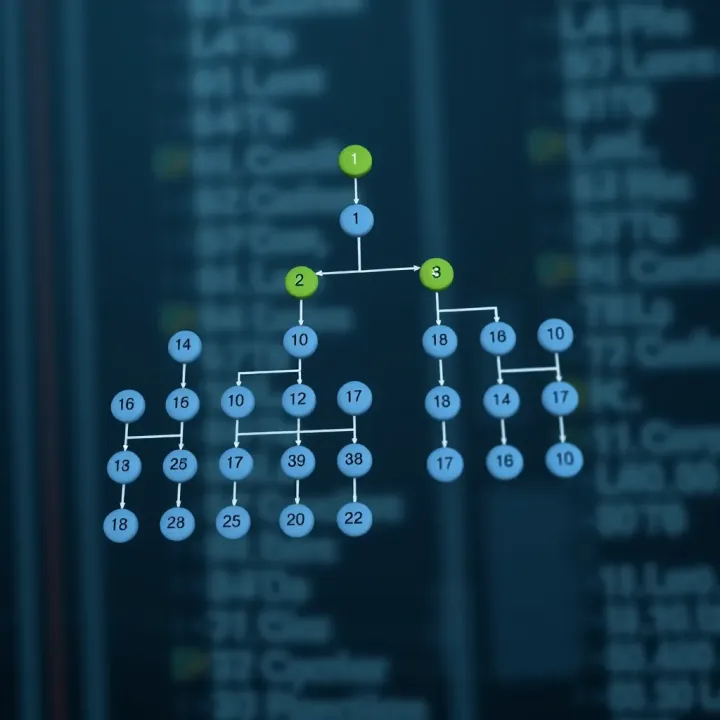
A binary tree begins with a single node known as the root. Each node may link to zero, one, or two child nodes, which themselves are roots of smaller subtrees. This recursive nature makes binary trees particularly flexible and useful.

Each node has up to two children, no more.
Nodes are arranged in levels starting from the root at level 0.
Traversing a binary tree involves visiting nodes in a specific order, which influences how data is processed.
Binary trees simplify complex datasets by breaking them down into smaller manageable parts, enabling rapid data retrieval and manipulation.
Binary trees underpin many practical applications:
Search operations: Binary Search Trees (BST) keep elements ordered, speeding up searches to O(log n) on average. Indian software projects with large databases often rely on BSTs for fast queries.
Expression parsing: Compilers use binary trees to parse mathematical expressions.
Priority queues: Implemented using binary heaps for task scheduling or memory management.
Routing and decision-making: Binary tries help in network routing algorithms.
Consider an e-commerce platform like Flipkart or Amazon India. When a user searches for a product, the platform needs quick access to product details and prices. Binary trees can organise product data to ensure this search happens swiftly, even when there are lakhs of items listed.
In short, understanding binary trees gives programmers and analysts a valuable tool to optimise algorithms and handle data efficiently. The upcoming sections will look at the types of binary trees, popular traversal techniques, and their applications to help deepen your grasp of this topic.
Binary trees form the backbone of many computer science concepts, particularly in data structures. Their design allows efficient organisation and retrieval of information, which is essential for applications like database indexing, search algorithms, and even machine learning. To grasp the full potential of binary trees, you need to understand their basic structure and how they differ from other tree types.
At its core, a binary tree is a hierarchical structure made up of nodes, where each node can have up to two children: left and right. This simple rule distinguishes binary trees from general trees, which may have multiple children per node. Each node typically contains data and references to its child nodes, enabling traversal and manipulation. For example, think of a family tree limited to parents and their two children; this restriction simplifies many operations compared to more complex family structures.
There are several common examples to illustrate binary trees:
Expression trees, where internal nodes represent operators (+, -, *, /) and leaf nodes are operands, helping in parsing and evaluation of mathematical expressions.
Binary search trees (BSTs), where nodes are organized to facilitate quick search, insert, and delete operations based on value comparisons.
Heap trees, used primarily in priority queues, maintain a specific order property where parents are either larger or smaller than their children.
These practical examples are widely used in programming and software development, including coding challenges faced by Indian developers in competitive exams and real-world projects.
Binary trees provide a way to organise data hierarchically, making them ideal for scenarios demanding fast access, insertion, or deletion. In the context of data structures, binary trees underpin critical algorithms that keep operations efficient, especially when dealing with vast datasets or dynamic information.
Understanding binary trees is key if you want to write optimised code or work on database engines, search algorithms, and even file systems. Their structure balances simplicity with functionality, which is why they are a staple topic in computer science curricula across India and globally.
Binary trees might seem straightforward, but their impact on computing efficiency and problem-solving strategies is profound and far-reaching.
This section lays the groundwork for exploring types, operations, and applications of binary trees that follow in the article.

Understanding different types of binary trees is essential for selecting the right structure in programming and algorithm design. Each type has specific rules and use cases, affecting how efficiently data can be stored, accessed, or manipulated.
A full binary tree is one where every node has either zero or two children—no node has only one child. This strict structure simplifies certain operations. For instance, in heap implementations used in priority queues, full binary trees ensure a well-defined shape for easy navigation. Imagine a family tree where each parent has exactly two children or none; this turns navigation logical and predictable.
Complete binary trees fill levels entirely, except possibly the last one, which fills from left to right without gaps. This property helps in optimising array-based representations of trees. For example, binary heaps implemented for sorting algorithms rely on complete binary trees for efficient insertions and deletions, since the tree remains compact and balanced naturally. Consider a tournament bracket where matches fill up from leftmost slots without empty gaps — it’s a real-life analogy illustrating this concept.
A perfect binary tree is both full and complete—all internal nodes have two children, and all leaf nodes are at the same level. Such trees have the minimum height needed for the number of nodes, optimising operations like searching. Balanced decision trees or certain binary search trees during perfect balance scenarios resemble perfect binary trees. In an ideal chess tournament where every round halves remaining players with no byes, the structure forms a perfect binary tree.
Balanced trees maintain their height as low as possible to optimise search and insertion times. Trees like AVL or Red-Black (covered later) enforce such balance. In contrast, degenerate trees behave like linked lists, where each parent has only one child—making operations inefficient with time complexity degrading to linear. Picture a phone directory sorted alphabetically but skewed heavily to one side; accessing entries becomes cumbersome. Balance ensures quick access while degeneration leads to delays.
Choosing the right type of binary tree impacts performance at scale. For Indian software projects handling big data or real-time operations, understanding these types guides efficient coding and resource use.
By recognising these categories, you align data handling with your application's needs, whether it's a compact heap for scheduling or a balanced search tree for faster queries.
Binary trees come alive in computer science largely due to the operations you perform on them. Understanding these key operations helps you manipulate data effectively, especially in complex applications like databases, file systems, and memory management. Operations such as insertion, deletion, traversal, and searching form the backbone of algorithms that rely on binary trees.
Insertion and deletion allow you to modify the tree structure dynamically. When you insert a node into a binary tree, you maintain its properties—whether it's a simple binary tree or a binary search tree (BST). For example, while building an Indian stock inventory system, inserting new product data ensures the tree keeps the order intact for quick retrieval later.
Deletion, on the other hand, requires careful handling. Removing a node can disrupt the tree’s balance and order, especially if the node has one or two children. Consider an employee management app where deleting an employee record from a hierarchically organised tree demands rearranging links carefully to avoid losing connection between nodes.
Traversal is about visiting nodes in a specific order. It’s essential because trees () do not store data linearly, so you must decide how to access elements based on the task at hand.
Inorder Traversal visits the left subtree, then the root, followed by the right subtree. This method retrieves data in ascending order for a binary search tree, useful in sorting tasks or printing products by their price. For example, an e-commerce platform sorting items by cost uses inorder traversal to list products neatly.
Preorder Traversal processes the root first, then the left and right subtrees. This approach is often used for creating a copy of the tree or evaluating prefix expressions in calculators. Imagine a coding platform demonstrating expression evaluation; preorder traversal helps evaluate operations in the right order.
Postorder Traversal visits children before the root, making it suitable for deleting trees or evaluating postfix expressions. In system file deletions, postorder traversal ensures subfolders are deleted before their parent folder.
Level-order Traversal (or breadth-first traversal) visits nodes level by level from top to bottom. This method is handy for shortest-path problems or printing tree levels. In a telecommunication network, level-order traversal can model message broadcasting layer-wise.
Searching in binary trees depends on the type of tree. In binary search trees (BSTs), searching is efficient because you compare node values and discard half the tree at each step, similar to looking up a word in a dictionary.
For other trees without sorted order, search is done by traversal methods like preorder or level order, which may take longer. For instance, an app scanning contacts stored in a tree without sorting will visit each node to find a match.
Efficient key operations on binary trees enable better performance in software applications, making them essential skills for programmers and analysts alike.
Binary trees are widely used in computer science due to their versatile structure, making them key in various practical applications. Their hierarchical setup facilitates operations that involve ordered data storage and retrieval, making them indispensable in fields like compilers, databases, and networking.
Binary trees play a significant role in parsing mathematical expressions. Expression trees represent operations with internal nodes as operators and leaves as operands. For example, the algebraic expression (3 + 5) * (2 - 7) can be represented as a binary tree where multiplication is the root node, and addition and subtraction are the child nodes. This structure allows easy evaluation through traversal techniques, usually postorder, where operands are processed before the operator itself.
This approach simplifies complex expressions in compiler design and calculators, allowing step-by-step processing. In Indian coding interviews and software development, understanding expression trees is a popular way to solve parsing problems efficiently.
Binary trees underlie many searching and sorting algorithms. Binary Search Trees (BST) maintain sorted order, allowing quick search, insertion, and deletion, which is essential in managing dynamic datasets. For instance, an e-commerce website managing inventory with frequent updates benefits from BSTs to keep products searchable by price or ID.
Sorting algorithms such as Tree Sort leverage binary trees by inserting unsorted elements into a BST and performing an inorder traversal to retrieve sorted results. This method has practical utility where in-place sorting is either complex or inefficient.
A Binary Search Tree organises data to maintain order, so you can locate an element quickly compared to linear methods. BSTs offer average search, insert, and delete operations in O(log n) time, making them preferred for real-time applications.
Besides speed, BSTs support dynamic data sets efficiently where data keeps changing, unlike arrays that may require costly reshuffling. They’re particularly useful in Indian fintech apps for quick lookup of user accounts or transaction details.
Binary trees, through their structure and adaptability, form the backbone of various algorithms and applications. Understanding their use cases helps in designing more efficient software systems, especially where data must be processed and fetched quickly.
Implementing binary trees in programming gives practical insight beyond theory. It highlights how trees organise data in memory, allowing efficient operations like searching, insertion, and deletion. For Indian software projects involving hierarchical data—such as company structures, file systems, or language parsing—binary trees become quite handy.
Understanding how different programming languages handle binary trees helps you choose the right tool for a task. Some languages provide built-in support or libraries, while others require custom implementation. This section explains these approaches and gives real-world examples to clarify key concepts.
Languages like C, C++, Java, and Python differ in implementing binary trees. In C and C++, pointers and dynamic memory allocation offer precise control, suitable for performance-critical applications like embedded systems or trading platforms. Java provides object-oriented constructs with garbage collection, making binary tree manipulation safer but potentially slower.
Python, popular among data scientists and beginners in India, uses dynamic typing and built-in data structures. It can create binary trees easily using classes, though it’s generally less efficient for large-scale usage. Still, the simplicity aids learning and quick prototyping. For example, in Python, each node is an object holding data and references to its children.
Here's a simple Python snippet demonstrating a binary tree node and basic insertion:
python class Node: def init(self, key): self.left = None self.right = None self.val = key
def insert(root, key): if root is None: return Node(key) if key root.val: root.left = insert(root.left, key) else: root.right = insert(root.right, key) return root
root = Node(50) root = insert(root, 30) root = insert(root, 70) root = insert(root, 20) root = insert(root, 40) root = insert(root, 60) root = insert(root, 80)
This code defines a Binary Search Tree (BST), where the left child values are less than the parent node and right children greater. This property provides efficient searching, especially useful in applications like stock price lookups or employee ID sorting.

### Common Mistakes to Avoid

Working with binary trees, developers often stumble on a few key issues:

- **Ignoring Base Cases:** Forgetting to handle `None` or empty nodes in recursion causes runtime errors.
- **Incorrect Pointer Assignments:** Overwriting node references without proper linking corrupts the tree structure.
- **Assuming Balanced Trees:** Inserting without balancing can degrade performance to that of a linked list, especially in sorted data inputs.
- **Confusing Tree Traversals:** Mixing up preorder, inorder, and postorder leads to wrong data processing, affecting applications like expression evaluation.

> A simple slip in pointer management or recursion can turn a neat binary tree into a tangled mess. Always test small cases and visualise tree structure during development.

Getting hands-on with binary trees in actual code solidifies your understanding and prepares you for complex data problems common in data analysis, algorithmic trading, and software development projects in India and abroad.

## Challenges and Optimisations

Binary trees are a fundamental part of data structures, but working with them involves challenges, especially when trees become unbalanced. An unbalanced tree can drastically increase the time complexity for operations like searching, insertion, and deletion. In practical applications, such as search engines or trading algorithms, slow performance due to an unbalanced binary tree might delay decisions or affect responsiveness.

### Handling Unbalanced Trees

Unbalanced trees occur when one subtree is significantly deeper than the other. This situation can happen naturally when nodes are inserted in a sorted or nearly sorted manner. For example, inserting elements in ascending order into a binary search tree (BST) results in a skewed tree resembling a linked list. The depth increases to the number of nodes, causing search operations to degrade from O(log n) to O(n).

This imbalance affects not just search efficiency but also space utilisation and cache performance. Consider an Indian e-commerce platform managing product inventories: slow searches for product IDs directly affect user experience during peak sale seasons. Handling unbalanced trees involves detecting imbalance and restructuring the tree to improve efficiency.

### Balancing Techniques

#### AVL Trees

AVL trees maintain strict balance by ensuring that the difference in heights (balance factor) between the left and right subtrees of any node is no more than one. Whenever an insertion or deletion disrupts this balance, rotations are applied to restore it. These rotations are simple operations that rearrange nodes without breaking the binary search tree properties.

For instance, in a stock price monitoring tool where quick access to recent transaction data is critical, AVL trees help maintain fast searches and updates. Their strict balancing can, however, lead to more rotations and extra processing compared to other structures, but the trade-off is faster lookup times.

#### Red-Black Trees

Red-Black trees offer a more relaxed balance condition compared to AVL trees by colouring nodes red or black and enforcing rules during insertions and deletions. This balance allows the tree’s height to remain roughly logarithmic to the number of nodes.

Red-Black trees are favoured in many real-world systems, including databases and file systems, thanks to their good balance between balancing overhead and performance. For example, Indian banking software handling millions of transactions can use Red-Black trees to ensure consistent speed in retrieving customer records.


Overall, understanding these challenges and optimisations allows you to implement binary trees that stay efficient even with large datasets, making them reliable for practical applications in India’s fast-growing digital sector.🔍 Explore the binary search algorithm: how it works step-by-step, its time complexity, limitations, and practical coding tips in data structures and algorithms for efficient searching.

Explore one way threaded binary trees 🌳 for faster traversal using unused pointers. Learn structure, benefits, techniques, and applications with clear examples.
Explore level order traversal in binary trees 🌳: learn how it works, how to implement it, compare it with other methods, and see real-world uses in detail.

Explore how to efficiently perform level order traversal in binary trees using queues 📚. Understand its basics, applications, and variations with clear examples.
Based on 10 reviews